Thursday, May 10, 2012

Steep hillside installation Diamond Heights San Francisco


This steep hillside was dominated by cotoneaster, lorapetalum, salvias and agapanthus.   Before installation photos are center right, installation photos are center left.
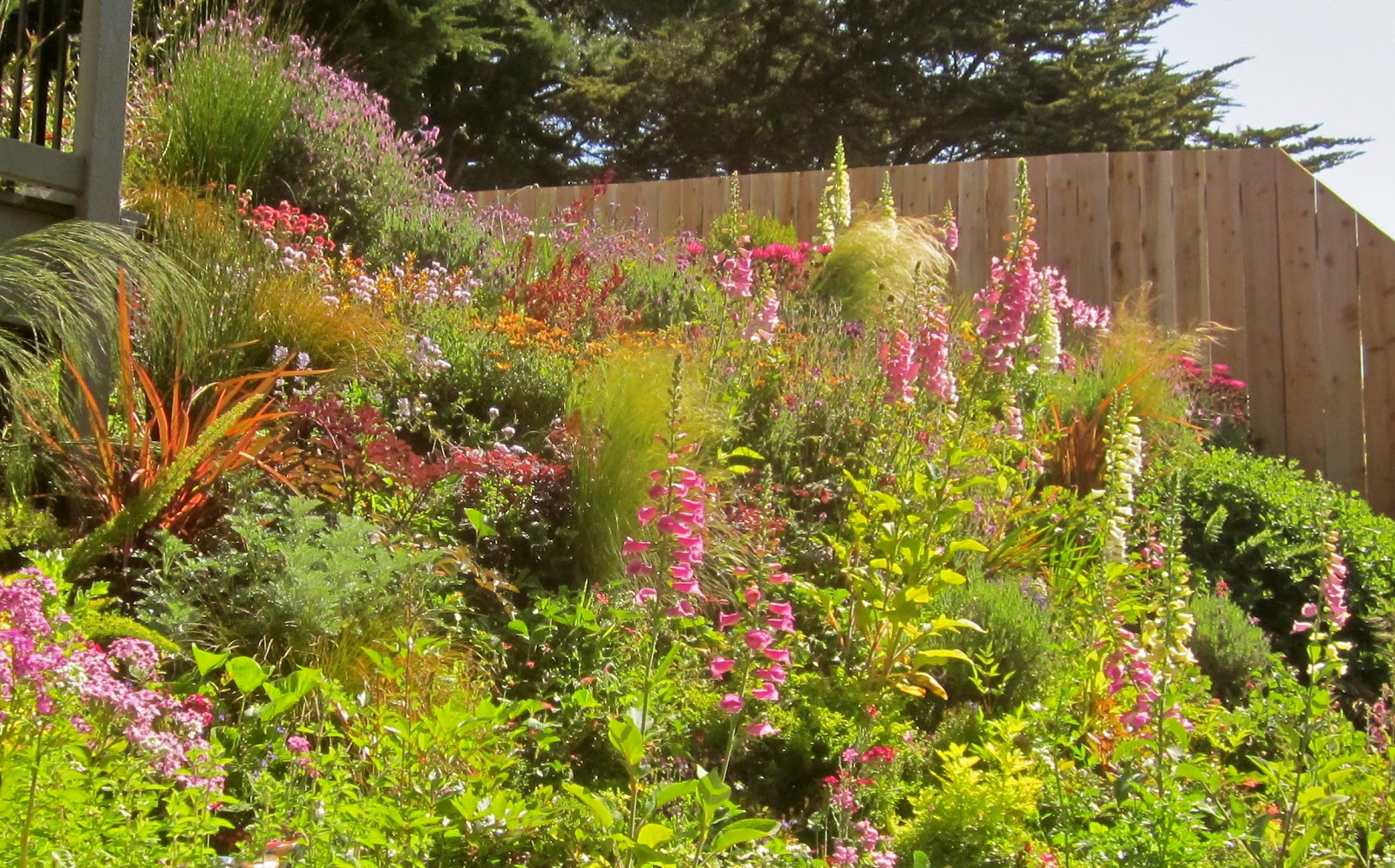


Now it has a mosaic of Mediterranean plants, phormium, chondrapetalum, armeria, digitalis, douglas iris, feather grass, lavender, arctotis, ceonothus, fever few, cinneria, euphorbia, salvia, sage, carex, daffodils, thyme, gravelia, lobelia, mimulus, rosemary and ribes speciosum (fuchsia flowering goosebery) are the major contributors.


Saturday, February 19, 2011

Azara dentata / oka (oxalis tuberosa)

These are some potatos and Oka tubers (oxalis tuberosa) I harvested from my patio planters this month. I chopped and baked them with garlic and olive oil, delicious! The oka is crunchier but otherwise similar to potatos and remains a staple food for Andean peoples.


Azara is in the family Salicaceae, native to temperate to sub-tropical Chile. I believe the 4 trees I have in the community garden are Azara dentata.

They are large evergreen shrubs to small trees growing to 8 m tall. If left un-pruned the trees would have a vase shape, but I like to keep them open and not too tall. They are great trees for pruning. The leaves are alternate, but may look paired in some species, they are simple rounded and short 1-9 cm long and 0.5-5 cm broad. The flowers are small and look like yellow puff balls, reminds me superficially of acacia, they are very fragrant. The flowers has a 4-5-lobed calyx with no petals, but conspicuous long, brightly colored, stamens. It flowers in the San Francisco in late January through February. The fruit is a red to black berry 3-10 mm diameter and sparse.

Monday, February 7, 2011


On my visit to the SF Arboretum today I was able to find four California quail where I had found a pair last spring. These quail are almost locally extinct in San Francisco due to feral cat predation and degradation of suitable habitat. To my knowledge there are only 1-3 hens left in the entire city. I felt very fortunate to see this female with three males in tow. Hopefully they will hatch and raise many young birds this spring.

Monday, January 17, 2011

Gardening with chickens


In 2009 I started gardening with a companion chicken named Cinnamon. I borrowed her from a good friend in Fairfield who identified her as not fitting in with the rest of the flock. I was unable to keep her over the summer but received a different Cochin this January. Elizabeth named her Sugar.

Sugar stays in a large rabbit cage when at at home and travels in a cat carrier in my car to my gardening jobs. I like gardening with cochin chickens because they are quiet and calm birds with determined yet friendly dispositions.

She love to eat weeds and gets the occasional worm for her efforts. The forage she gets from a days work helps to enrich her lovely brown eggs. In my family we view Sugar as a pet and treat her as kindly as our family dogs.

Having Sugar work with me helps to encourage my colleagues and clients to consider keeping chickens and fosters a better understanding of perma culture and the need to treat farm animals humanely.

Sunday, January 16, 2011

Salvia conferiflora (red-velvet salvia)


A native from Brazil that will reach 4-6 feet in height and width in one season. It has large dark green leaves, with a yellow undertone, with serrated edges, and with velvety red-brown hairs on the petiole and stem of the new leaves.

Flower inflorescences reach up to 2 feet long and are covered with velvety red-brown

hairs, with the stems of the inflorescence and the calyx also having a red-brown color. The .5 inch flowers are orange-red, and very profuse, explaining the epithet confertiflora, or "crowded with flowers". The plant grows so large that it needs staking and protection from wind in gardens.

Hummingbirds love it and it blooms year around in San Francisco.

Tuesday, April 27, 2010

Pink flowering currant, ribes sanguineum v. glutinosum "Claremont"
This is a california native that has beautiful spring flowers, maturing in to purple/bluish berries with a silvery sheen.

Humming birds and native bees love the flowers and the berries attract grossbeaks, thrushes, waxwings and other birds.

This shrubby small tree has multiple trunks and does not get too large 10-15 feet at most. Making it a great addition to any garden.

Saturday, April 24, 2010


Pride of Madeira

Family: Boraginaceae

Origin: Native to the Canary Islands


Hardiness: Hardy in zones 9 and 10 only; best at coast
Growth: Rapid growth to 8 feet with wider spread
Form: Naturally a wide mound, but can be pruned to upright form
Leaves: Gray-green 8 inch narrow leaves at end of stems
Flowers: Blue to purple 1/2 flowers in long spikes in spring
Fruit or Seeds: Remove flower spikes when they fade
Exposure: Full sun; good at coast
Water: Weekly to monthly or none at all during summer
Soil: Well drained; grows in poor soil
Fertilizer: Fertilizer causes rapid growth and poor flowering
Prune: To shape and to expose branches
Problems: Snails; root rot if drainage is poor

Spectacular plant in coastal areas. Echium comes in a variety of rich blues and purples. Easily rooted from cuttings.

Friday, April 23, 2010

Black Mondo grass Ophiopogon planiscapus 'Nigrescens') This cultivar was developed in England but the species is from Japan.

It likes partial to full shade, does well from boggy to dryish soil, and when established needs only weekly water. It will send out runners and slowly spread to form a loose "colony" of plants.

I use this plant a lot in SF shade gardens.
Installation I did in 2009 including the paver stones.
Shade garden installed in 2008.
This is a small installation I did in 2009, drip irrigation and bricks were also installed by me.

Monday, April 7, 2008

Recent installation March 2008

This is a recent installation for clients of mine. The bottom three photos were taken prior to the installation.


We discussed a mediterranean look that was not so formal. The owners did not like the height of the flowering maple nor did they care for the border of variegated mondo grass.
I kept the japanese maple, the roses and some of the boxwood. I hard pruned the roses to reduce their height.


Saturday, March 22, 2008

Plant Pick for March: Aeonium arvoreum "Schwartzkopf'

I have been grooving on aeoniums since the early 90's and have really fallen for this "black" pigmented form.

This species originated in the Canary Islands which has comparable micro climates to San Francisco.

The deepest darkest colors of A. 'Schwartzkopf' are achieved with full sunlight; shade this plant and it will become green tinged.In winter the centers of the rosettes lose their black pigment turning green, they darken again in spring.

After two years some of my plantings are 4ft tall and finally blooming. The yellow flower spike on the black foliage is really beautiful.

Great for height and structure in a succulent garden.

Plant Pick for March: Salvia gesneraflora 'Tequila'

This salvia is my favorite red flowering variety.

S. gesneraflora originates from Mexico, and creates an exotic tropical look in my garden when in bloom.

It blooms from mid to late winter into summer in San Francisco when most shrubs are dormant. Hummingbirds are very attracted to its large red flowers.

S. gesneraflora forms a solid trunk within two years and grows like a weed requiring a fair amount of pruning to keep it from smothering its neighbors.

I have it planted amongst other shrubs and small trees where it remains in the back ground until it blooms, taking the center stage.

Plant Pick for March: Primula hybrid 'Gold Lace'

I first saw this hybrid about two years ago and had to add it to my garden immediately!

Primula 'Gold Lace' became popular with English florists in the mid 1700's. It later fell out of favor and was becoming extremely rare until its recent resurgence in popularity.

The flowers of this primula seem to jump out from the shaded under-story to catch your eye without dominating the space. The color of the flower is a satiny deep red almost black out-lined in vivid gold surrounding a golden center.

I like to place this little gem in small groupings in shaded areas near enough to a path to draw the eye.

Friday, March 21, 2008

Plant Pick for March: Oxalis spiralis 'aurea'


Each month I am going to feature some of my favorite plants.

Oxalis spiralis 'aurea'.


This clumping oxalis varies in color from chartreuse to pinkish orange depending on light exposure and amounts of water. O. spiralis is found in mountainous forests from Central America south throughout the Andes mountain range. This species has adapted to different conditions and shows a high degree of physical variability in the wild.

They absolutely thrive in San Francisco's moist cool weather! I like to mix them in with grasses, sedges and mosses.

Sunday, March 16, 2008

Centerpiece gardens


I recently celebrated my daughters 5th birthday! Our wonderful neighbor catered the party so I was able to focus on the decorations. I wanted to create some beautiful gardens in miniature. By combining flowers for my daughter mixed in with more unusual plants like black mondo grass, and oxalis spiralis aurea I created some very nice pieces. Not pictured were many ceramic Easter eggs, bunnies and chicks to go along with the Easter theme (I want to stay focused on the plants for my blog).